
Rowing Motivation: Why Values Beat Feelings Every Time

You wake up for rowing practice and your first thought is “I really don’t want to do this today.”
So you wait. You think if you just lie there for five more minutes, hoping your rowing motivation will show up. You scroll your phone looking for something inspirational. You try to remember why you started rowing in the first place.
Sometimes it works. The feeling arrives, you get to practice, everything’s fine.
But most days? The motivation never comes. You either drag yourself to the boathouse feeling terrible about it, or you skip and feel worse.
Here’s the problem with relying on rowing motivation: you’re waiting for a feeling to arrive before you act. That’s the equation most rowers use, and it’s backwards.
Most athletes operate with this mental model:
Motivation → Action → Results
It makes sense on the surface. Feel motivated, then train, then get faster. Simple.
Except this equation has rowing motivation in the wrong place.
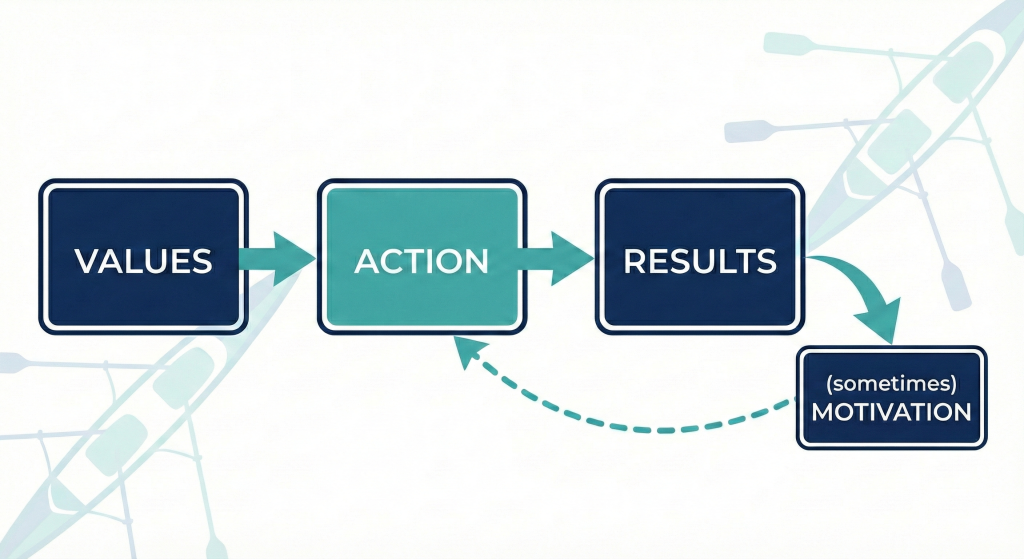
The real equation looks like this:
Values → Action → Results → (sometimes) Motivation
Notice where motivation appears. At the end. As a possible bonus. Not as the requirement to start.
This isn’t just rearranging words. This completely changes how you approach training when you don’t feel like it.
In the wrong equation, when motivation disappears, you’re stuck. No feeling means no action. You’re waiting for your brain to randomly cooperate, which it might or might not do depending on how you slept, what you ate, whether it’s raining, and about thirty other variables you can’t control.
In the right equation, motivation is irrelevant to whether you train. You act based on what matters to you. The feeling might show up afterward, or it might not. Either way, you already did the work.
Your Racing Brain, the automatic system that actually runs your behavior under stress and fatigue, needs reliable feedback loops.
When you operate from motivation, you’re asking Racing Brain to invest effort with no guaranteed payoff. Sometimes you feel motivated after training. Sometimes you feel exhausted and miserable. Racing Brain hates that unpredictability.
When you operate from values, you give Racing Brain consistent feedback: effort invested → value honored → identity reinforced.
This works every single time regardless of how you feel.
You can honor your value of being a reliable teammate whether you feel motivated or not. You can honor your value of discipline whether practice is hard or easy. You can honor your value of growth whether you PR or have your worst piece of the season.
Racing Brain can work with that consistency. After enough repetitions of “don’t feel motivated → act on values anyway → survive,” showing up becomes automatic. Not because you’ve learned to always feel motivated, but because you’ve built a pattern that doesn’t require the feeling.
Your Training Brain, the rational system, already knows you should train when you don’t feel like it. But Training Brain goes offline when you’re tired or stressed. (Learn more about how these two brain systems work in rowing.) You need to train Racing Brain directly through values-based repetition.
Here’s how you actually use the right equation for consistent rowing performance.
Before motivation drops, identify what you value about rowing. Not what you think you should value. What actually matters to you.
Maybe you value being part of something bigger than yourself. Maybe you value proving you can do hard things. Maybe you value the identity of being someone who doesn’t quit. Maybe you value physical challenge or pushing your limits or teamwork.
Pick one thing that’s true.
Then when you wake up at 5:30 AM and don’t feel like training, you use this structure:
“I don’t feel motivated today AND I value [X], so I’m going to [specific action].”
Example: “I don’t feel motivated today AND I value being a reliable teammate, so I’m going to show up and complete the warmup.”
Notice the word “and.” Not “but.” Both things are true at the same time. You can have the feeling of not wanting to train and still take action based on your values. They’re not mutually exclusive.
This formula works because you’re not fighting the feeling or pretending it doesn’t exist. You’re just choosing to act from values instead of waiting for motivation.
Your Training Brain, the rational system, already knows you should train when you don’t feel like it. But Training Brain goes offline when you’re tired or stressed or comfortable in bed. You can’t think your way into motivation when Racing Brain is running the show.
You need to train Racing Brain directly through repetition: value identified → action taken → value honored. Do this enough times and it becomes the automatic pattern.
Here’s where people mess this up. They do the hard piece despite not feeling motivated. They finish. They think “I did it, I’m building discipline.”
But Racing Brain didn’t learn what you think it learned.
Without explicit reflection, Racing Brain files the experience as “that was terrible, avoid next time.” You completed the work, but the automatic system logged it under “unpleasant experience to minimize in the future.”
After you train on a low motivation day, you need to consciously acknowledge: “I didn’t feel motivated. I trained anyway. I honored my value. I’m capable of acting despite feelings.”
This reflection changes how Racing Brain categorizes the experience. Instead of “suffered and want to avoid,” it becomes “demonstrated values-based action works independent of feeling state.”
That’s the actual training stimulus. Not just doing hard things. Doing hard things while connecting them to values and noting the gap between feeling and action. Research on applying mindfulness and acceptance-based strategies among athletes supports this values-based approach to athletic performance.
A competitive rowing season is eight to ten months. You will not be motivated for all of it.
The rowers who improve most aren’t the ones who feel motivated every day. They’re the ones who show up consistently regardless of feeling.
When you’re using the wrong equation, every low motivation day feels like a crisis. You’re constantly fighting to generate a feeling that may or may not arrive.
When you’re using the right equation, low motivation days are just Tuesday. The feeling is irrelevant. You identified your value, you know the action, you execute.
Over a season, this difference is massive. One approach requires constant emotional management and hoping your brain cooperates. The other approach works the same on every single day regardless of how you feel.
According to research on motivation and self-determination in athletes, values-based action creates more sustainable performance patterns than extrinsic motivation alone.

Before your next practice, write down one value. “I value _____.” Pick what’s actually true for you about rowing.
Tomorrow morning when you don’t feel like training, say out loud: “I don’t feel motivated today AND I value [your value], so I’m going to [specific action].”
Keep the action small. Just commit to showing up and completing the warmup. That’s it.
After practice, ask yourself: “Did I honor my value today?” If you showed up despite low motivation, the answer is yes. That’s the win.
Do this for two weeks. Notice what changes. Not whether you feel more motivated, but whether the gap between “don’t feel like it” and “doing it anyway” gets shorter.
That’s the pattern you’re building. Not learning to always feel motivated. Learning that motivation is optional for action.
The feeling might show up. It might not. Either way, you already trained.
The difference between struggling with motivation and building consistent training habits comes down to which equation you’re using:
Wrong equation: Wait for motivation → Try to act → Get frustrated when feeling doesn’t arrive
Right equation: Identify values → Act regardless of feeling → Build automatic patterns
Your Racing Brain learns through repetition, not through thinking or feeling. Give it enough examples of values-based action independent of motivation, and showing up becomes the default pattern.
Stop waiting for your brain to cooperate. Start training it to show up regardless.
Related Resources:
© 2025 Schary Consulting, LLC. All Rights Reserved