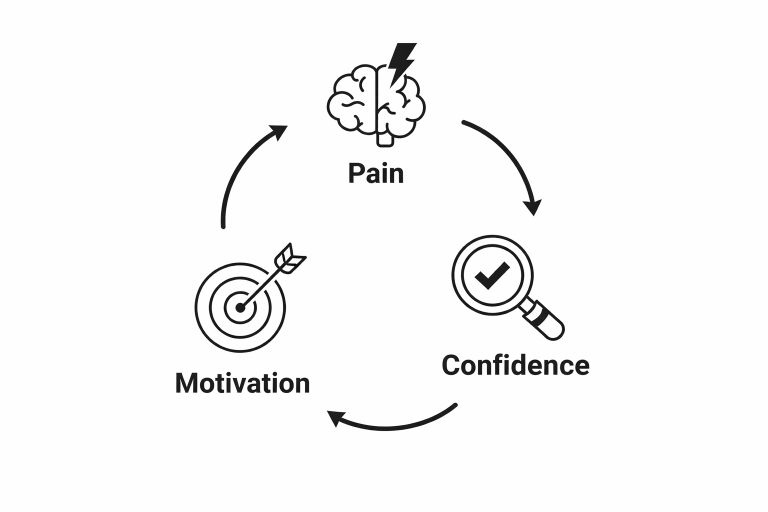
Hard rowing hurts, and your brain is wired to treat that sensation as a threat. When intensity rises, the Racing Brain prioritizes protection, not performance, which is why doubt, panic, or the urge to stop can appear even when you are physically capable of continuing. Learning to work with pain, rather than fight it, is the first step toward staying composed under pressure.
Key Takeaways
Why your brain sends "stop" signals before you're actually at your limit
The 3-question reflection protocol that recalibrates your automatic brain
How to execute when your Racing Brain says "quit"
Building Confidence
Confidence is not a feeling you wait for. It is the byproduct of repeated exposure, clear expectations, and proof that you can handle discomfort without falling apart. When rowers know what pain will feel like and how they respond to it, uncertainty drops and execution becomes more automatic.
Key Takeaways
What confidence really is and what it isn’t
Why comparison feels convincing but gives misleading data
Simple ways to collect evidence your brain can’t ignore
Motivation and Consistency
Motivation follows confidence, not the other way around. When the brain trusts that effort will not spiral out of control, showing up feels easier, even on low-energy days. Sustainable motivation comes from systems that make action the default, not from hype, guilt, or willpower.
Key Takeaways
Why motivation drops during long rowing seasons
Why consistency is a learned skill, not a personality trait
Practical systems that help rowers keep showing up
Get the Complete Quick Reference Guide
Everything from this series in one practical guide
Inside you'll find:
The 3-question reflection protocol that drives recalibration
Evidence log template with real examples
Pre-race mental checklist
Emergency reset protocol for when everything falls apart
Coach integration strategies
30+ pages of tools you can use immediately in training.